Projects
- Details
- Published on Friday, 01 April 2011 18:07
- Hits: 3013
This program has joint the efforts of the electromagnetic visualization community working on the areas of electrodynamics, electromagnetic, numerical simulation, high frequency technology, system design, pattern recognition and information fusion to investigate, develop and experiment first prototypes of a new generation of radio systems based on a the use of Terahertz electromagnetic spectrum both, to interrogate the matter and to produce graphic information for the visualization and monitoring of a set of original significant new parameters of physical and geographical phenomena.
More precisely, the activities initiated by the Programme have been:
- The definition and construction of a terahertz networked laboratory infrastructure at national level able to support the development of the different devices and subsystem:
· THz Physical and Numerical Modeling Joint Laboratory.
· THz Device technology lab assembled a test-set until 110 GHz.
· THz Radiation Measurement Joint laboratory
- The construction of the three prototype instruments:
· A 0.1 THz band THz Short-Range Real Time 2D Imaging Camera for Security Applications.
· A 0.3 THz band High Resolution Remote Sensing Imaging Radar for Environmental Monitoring.
· A 0.5-3 THz Near-Field System for Biostructures Sensing and Imaging.
1. Model of THz scenes using Blender (a free open-source 3-D content creation suit)to assess the performance of a MMW imaging system and determine if certain patterns will be distinguished for a given set of scene temperatures and image system parameters.
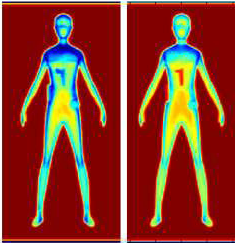
Fig. 1. Simulated passive millimeter-wave images, temperature in K, resolution 500 x 300 pixels (a) Outdoor, (b) Indoor.
2. Study of different face recognition systems: a commercial one (VeriLook SDK), PCA-SVM system, and DCT-GMM system. This is done in different environments (at short, mid and long distance) and with images acquired at the visible band of the spectrum. Mid and long distance scenarios are the ones where the GHz images are usually acquired. Therefore this approach constitutes the base to compare the behaviour of systems that use GHz images.
3. Generation of a database, called BIOGIGA, composed of 1200 synthetic images at 94 GHz of the body of 50 individuals. The images are the result of simulations carried out on corporal models at two types of scenarios (outdoors, indoors) and with two kinds of imaging systems (passive and active). These corporal models were previously generated using MakeHuman free software, based on body measurements taken from the subjects. Blender software was used to simulate the images at 94 GHz from the corporal 3D models.

Fig. 2. Synthetic images of one user simulated at 94 GHz, in different scenarios (indoors and outdoors) and with different imaging systems (passive and active).
4. Distance-based feature extraction for biometric recognition of Millimeter Wave body images. The developed extractor is tested on the previously described database. The results prove that the use of a small number of distance-based features provide good class separation.

Fig. 3. Main steps followed to extract the features from the image.

Fig. 4. Two dimensional representation of the discrimination power of the extracted features: (a) 2nd PCA component vs 1st PCA component and (b) Waist width vs height. Each cluster formed by the same kind of symbols represents an user.
5. Development of a high performance FDT parallel simulator. It has been included in a synthetic environment to simulate the effect of high intensity radiated fields on modern aircrafts and rotorcrafts. It gives a reduction of computational times in the order of thousands without losses of accuracy
6. Software MONURBS for the analysis and design of structures in THz. MONURBS can solve the EFIE (Electric Field Integral Equation) and the CFIE (Combined Field Integral Equation). It can also deal with conductors, dielectric and magnetic materials. The program uses a highly parallelized version of the Multilevel Fast Multipole Method.
7. Software HEMCUVE (Hybrid Electromagnetic Code Universities of Vigo and Extremadura) extension: proposal and implementation of the high-scalability and high-efficiency MLFMA-FFT algorithm. Optimal performance on mixed-memory massively parallel supercomputers: high scalability O(NlogN) method.
- Rigourous solution of the largest computational electromagnetic problems to date: 500, 620 and 1000 million unknowns. This software has been awarded with two prizes: PRACE Award 2009 and Itanium Innovation Alliance Award 2009, in computationally intensive applications.
- Current World record in computational electromagnetics: solution of the NASA Almond target at 3 THz (1000 million unknowns) using 1024 parallel processors, 5TB RAM and 35 hours of wall-clock time in the Finis Terrae supercomputer, at CESGA supercomputing center (ICTS-2009-40).
- HEMCUVE extension: development of surface integral-equation method of moments (SIE-MoM) formulation for metamaterial and plasmonic composite objects for efficient and highly accurate analysis of nanostructures in THz and optical regimes.

- Applied to the design of metamaterial super-lenses, nano-optical antennas for optical microscopy and spectroscopy, highly directive nano-optical antennas for wireless optical links and quantum processing, broadband nano-optical antennas for fiber to plasmonic guide interfacing.

Fig. 7. (left) Simulated perfect lens made of double negative (DNG) metamaterial; (right) simulated nano-optical gold-made plasmonic Yagi-Uda antenna at 817 nm.

Fig. 8. (left) Nano-optical silver-made Log-periodic broadband antenna for 600-1800 nm; (right) plasmonic metallo-dielectric antenna at 550 nm.
The device technology lab has developed several tools and procedures for analysis, design, assembling and characterization of devices and circuits at THz bands.
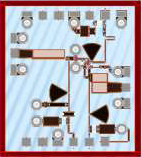
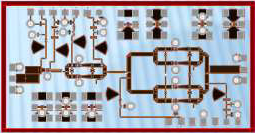
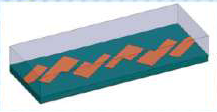
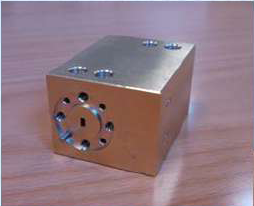

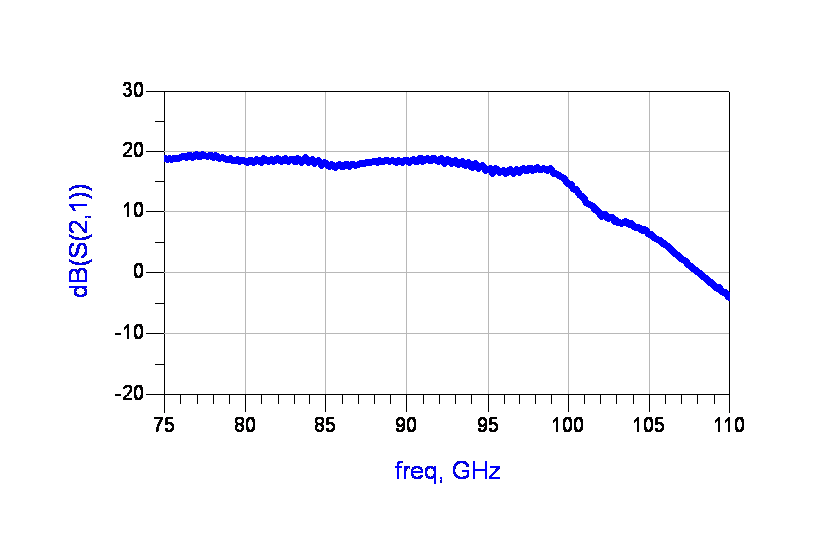
Fig. 1 From left to right – a) Low Noise Amplifier (LNA), b) High power Amplifier (HPA), c) Band Pass Filter, d) Transition Back to Back WR-10, e) PNAX with on-wafer probes upto 110 GHz, f) LNA gain measured on-wafer.
Custom-made waveguide-microstrip transition manufactured with standard PCB prototyping machinery. Adaptation is achieved in all the range of interest and losses are below 2dB.
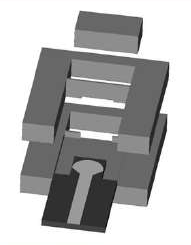
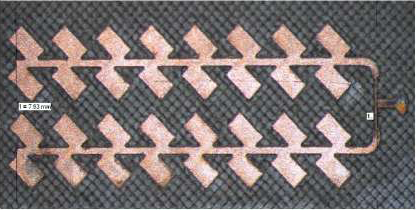
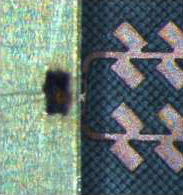
Fig. 2 From left to right – a) Waveguide-microstrip transition, b) Submillimeter wave antenna array for beem-Steering through frequency scanning, c) Array (b) with the transition (a).
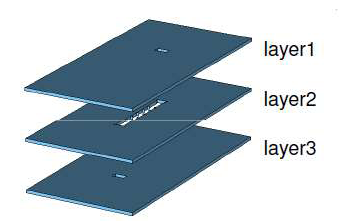
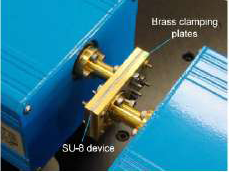
Fig. 3 Band Pass Filter
Design and analysis of the LC reflectarray demonstrator. Completed the reflect array design of different architectures and the stacked design is complete.
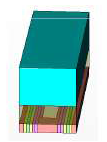
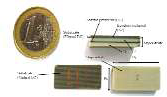
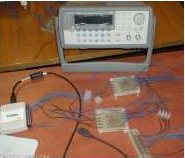
Fig. 4 LC Reflectarray
- Details
- Hits: 1992
The radiation sensor and measurement lab set in the UPM is currently setting up the configuration that will allow the measurements at 100 GHz and 300 GHz. The system is already tested in a test environment. The components have been chosen and bought and are currently installed in the laboratory.
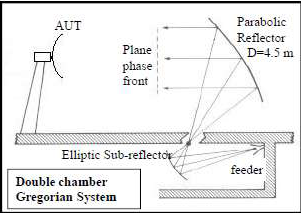
On the other hand, Antenna and scattering inverse techniques have been experimentally validated
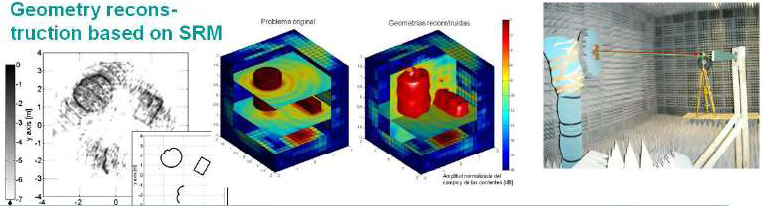
94 GHz Passive Imager with Mechanical Beam-Scanning
A 94 GHz passive imager prototype has been developed in the framework of the TeraSense project. The imaging system is based ont a Total-Power Radiometer with a mechanichal beam-scanning antenna. Figure 1 shows a photograph of the imaging system where both the radiometer and the scanning antenna are presented.
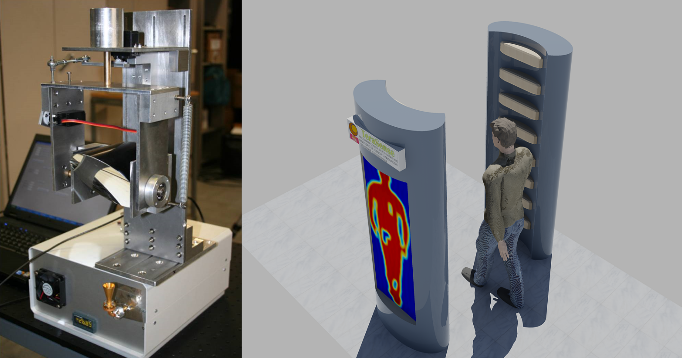
The main performance parameters of the system are summarized in the following points:
- Spatial resolution: 35mm
- Radiometric resolution: 0.3 K (70 ms integration time)
- Integration time per pixel: Adjustable (1ms - 500 ms)
- Scanning time: 7 minutes ( 100x50 pixels image with 70 ms integration time)
With this system, concealed objects under obscurants like clothes or luggage bags are revealed either in indoor or outdoor environments. Figure 2 shows two examples of acquired images in indoor and outdoor environments. In both environments the object is detected.

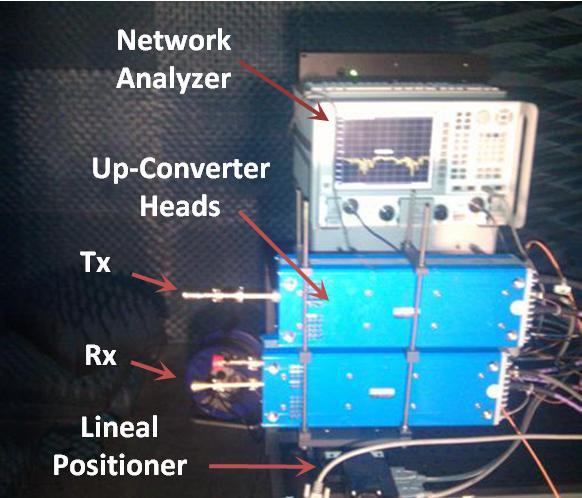
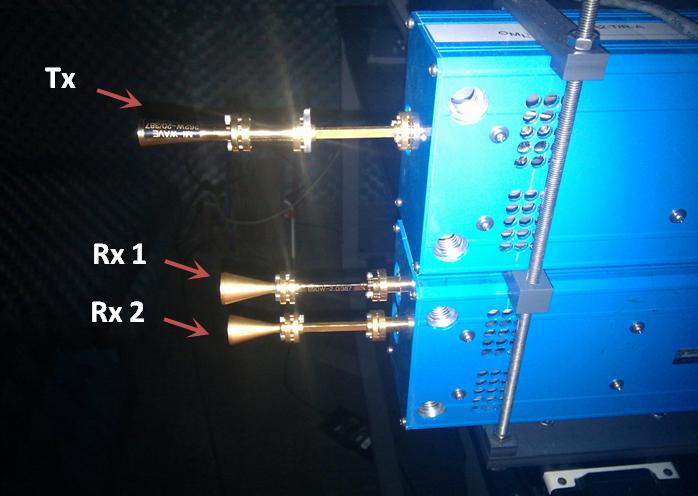
Fig.3. System instrumentation setup for deformation (left) and surface relief imaging (right).
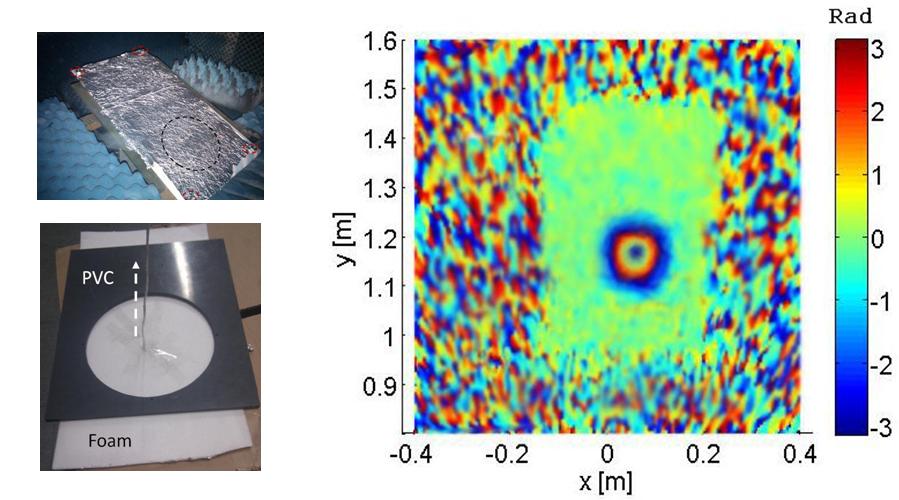
Fig.4. Pictures of front and back scene under test on the left, and deformation interferometric image on the right.
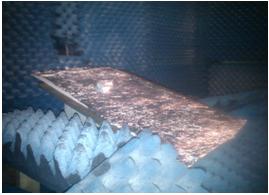
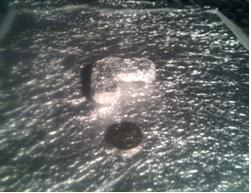
Fig.5. (a) Picture of the scenario under test. (b) Detail of the target to be detected.
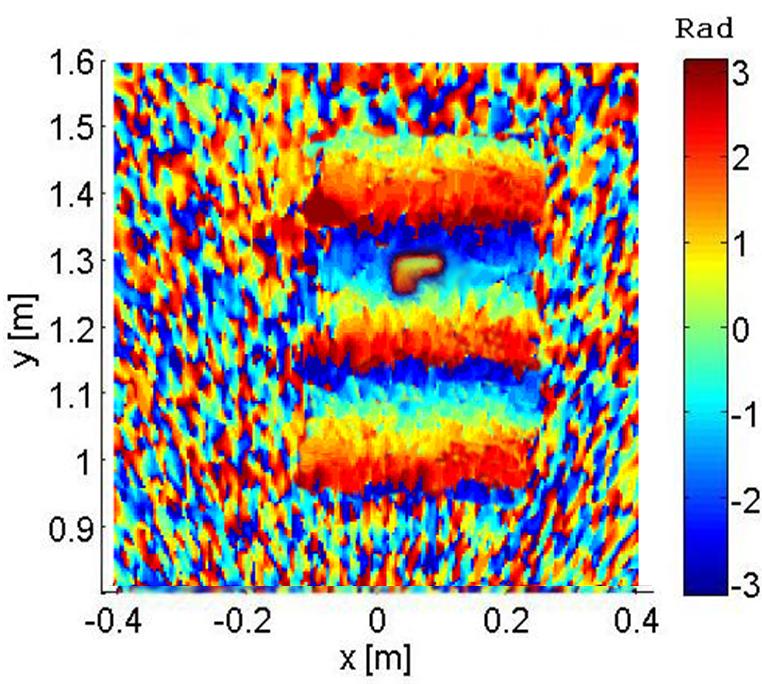
Fig.6. relief interferometric images.
100 GHz Near Field Imaging System
A near field imaging system for THz tomographic imaging based on a retina is being studied. This system will allow performing real time imaging.
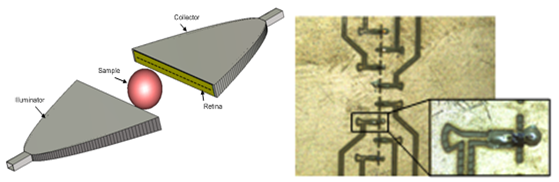
Fig. 7 (Left) Near Field imaging system. (Right) Fabricated retina of 8 slot elements with a PIN diode
300 GHz Radar for Environmental Remote Sensing
A radar at 300 GHz is being developed for the study of the attenuation due to atmospheric gas and clouds. The objective is to design, fabricate and test an all-solid-state active sub-millimeter imager that utilizes the swept-frequency FMCW radar technique to map a target in three dimensions with centimeter-scale resolution in both range and cross range.

Fig. 8 (Left) Photograph of the horn-antenna target located on the turntable platform
(Right) ISAR image of the horn-antenna target obtained from the data measured by the radar prototype.